

Amsterdam's Red Light District — De Wallen, to use its proper name — is one of the most misunderstood neighborhoods in Europe. Tourists either treat it as a theme park or avoid it entirely, and both approaches miss the point.
The district is a working residential area where sex work is legal, regulated, and part of daily life. It's also undergoing significant changes in 2026, from new rules about guided tours to stricter public behavior enforcement. Here's what you actually need to know before you go.
The Reality of De Wallen in 2026
De Wallen sits in Amsterdam's oldest neighborhood, a tangle of narrow lanes and canals that predate most of the city's famous canal ring. During the day, it's a quiet residential quarter with schools, churches, and family homes. After dark, the red-lit windows switch on, and the crowds arrive.
The district has changed dramatically in recent years. Amsterdam's city government has been actively working to reduce overtourism here, and several measures now directly affect visitors. Public cannabis smoking is banned in the district, Dam Square, and Damrak since 2023 — the fine is €100. Guided tours are no longer permitted in the narrow streets directly in front of sex workers' windows. And the city continues to push back on the rowdiest tourist behavior.
How the Red Light District Actually Works
The sex workers in De Wallen are independent entrepreneurs. They rent their window spaces by the day or shift, set their own prices, and screen their own clients. The women you see in the windows are working — this isn't a performance or a show.
The etiquette here matters. Don't photograph, film, or even point at the workers. Don't knock on windows unless you're a serious customer. And don't stand in front of a window for extended periods debating with your friends — it makes workers uncomfortable and can draw attention from bouncers or police.
If you're genuinely interested in understanding the district's history, the economics of sex work, and how Amsterdam regulates it, a guided tour is the smartest way to learn without stumbling through cultural landmines.
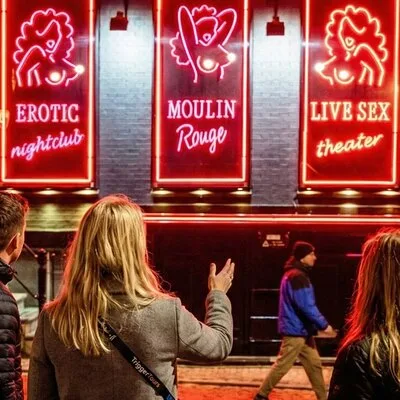
Amsterdam's Red Light District tour with a local
Join this 2 hour walking tour and discover the famous the “Red Light District”.
Book on ViatorThe Amsterdam Red Light District Walking Tour runs 1.5 hours with guides available in English, German, Italian, Spanish, and French. It focuses on the history of the sex industry and gives you context for exploring the window areas on your own afterward. Recent reviewers consistently praise the guides for answering questions people are often too embarrassed to ask — one solo traveler called it "very informative" and noted you'll know exactly how the process works before you consider engaging any services yourself.
The Rules You Must Follow
Amsterdam has gotten serious about behavior in De Wallen, and the rules are straightforward:
No photos, period. This is the most violated rule in the district. Sex workers have a legal right to privacy, and photography is treated as harassment. If you're caught taking photos near the windows, you'll be asked to delete them. Repeat offenses can lead to fines or arrest.
Don't buy drugs from street dealers. The district is full of people offering "coke" or "pills" — these are almost always scam artists selling fake substances or working with pickpockets. If you want cannabis, go to a licensed coffee shop. The city has been cracking down on street dealing, but you're still better off avoiding the interaction entirely.
Keep your voice down after dark. De Wallen is residential. People live above the sex clubs and souvenir shops. The city has imposed earlier closing times on bars in the center, and noise complaints are taken seriously.
Don't be a spectator. Standing in groups, pointing, laughing, and generally treating the workers as exhibits is disrespectful — and the city has been working to discourage exactly this behavior. If you're not a customer, keep moving.
Choosing the Right Tour for Your Interests
Not all Red Light District tours are the same, and picking the right one depends on what you want to get out of the experience.
The History and Culture Focus
If you want to understand how Amsterdam ended up with the world's most famous red light district, look for a tour that emphasizes history over spectacle. These tours cover the neighborhood's medieval origins, the Dutch approach to sex work regulation, and the current debates about the district's future.

Anne Frank's Amsterdam Jewish History WWII Exclusive Guided Tour
On this exclusive guided walking tour, Discover the Jewish Quarter and Amsterdam during World War II.
Book on ViatorThe Amsterdam: Red Light District guided tour starts near the Amsterdam Voyager Hotel and works its way through the old town and Chinatown before reaching De Wallen. It's a solid choice if you want broader Amsterdam context alongside the district itself. With 773 reviews and a 4.7 rating, travelers consistently note that the guides provide historical depth that transforms the experience from voyeurism into education.
The Coffee Shop Connection
Amsterdam's liberal drug policies and the Red Light District are historically intertwined. If you're curious about both, a combined tour makes sense — you'll learn how the city's approach to cannabis evolved alongside its approach to sex work.

Amsterdam Smoke Friendly Coffee Shop Cruise on Luxury Boat
Feel like being in the clouds and experience Amsterdam like never before on this, smoke-friendly Cloud Boat.
Book on ViatorThe Amsterdam Red Light District and Coffee Shop Tour covers De Wallen, Zeedijk Street, and Chinatown with a private guide. It's the most-reviewed option at 859 reviews with a 4.8 rating. Travelers mention that having a local guide makes the coffee shop experience less intimidating, especially if you're unfamiliar with Dutch cannabis culture. Note that this is a private tour, so you're paying for personalized attention — prices start around €55 per person.
The Budget-Conscious Independent Option
Since 2020, guided tours can't operate directly in front of the sex workers' windows. That means even the best walking tours give you context on the outskirts and then send you into the core area on your own. If you're comfortable exploring independently, a self-guided audio tour gives you the same background at a fraction of the cost.
The Amsterdam's Red Light District: A Self-Guided Audio Tour uses GPS to trigger commentary as you walk. It's a newer option with just 11 reviews so far, but the 4.7 rating suggests early adopters are satisfied. At roughly €8-9, it's significantly cheaper than a live tour and lets you set your own pace. The downside: you won't have someone to ask questions in the moment.
The Authentic Local Perspective
Some travelers want a tour that feels less like tourism and more like being shown around by a knowledgeable friend. These tours tend to be smaller and more conversational.
The Red Light District tour in Amsterdam positions itself as an authentic look at the neighborhood, with guides who emphasize the area's complexity. At 170 reviews and a 4.8 rating, it's a smaller operation than the major tour companies. Reviewers note that the guides are particularly good at explaining the district's current challenges, including the city's efforts to reduce the number of sex workers and crack down on tourist misbehavior.
What the Reviews Actually Tell You
Looking across the review data for all the major Red Light District tours, a few patterns emerge:
Guides make or break the experience. This comes up repeatedly. A knowledgeable guide transforms what could feel like rubbernecking into a genuine cultural education. Several reviewers specifically mentioned guides who were "knowledgeable, friendly, and very professional" — and notably, a few mentioned young guides handling sensitive topics with remarkable maturity.
Expect to have questions answered directly. The best tours create space for uncomfortable questions. One reviewer noted that the tour answered questions "one might be afraid to ask when shopping for said sex" — meaning the guides are matter-of-fact about the practical realities of how the district operates.
The district itself is intense. Multiple reviewers note that De Wallen is "not necessarily a great place to visit" in the traditional sense — it's confronting, crowded, and can feel overwhelming. That's not a reason to skip it, but it's worth knowing that this isn't a comfortable, easy sightseeing stop.
Timing Your Visit
The Red Light District operates on a clock that's different from the rest of Amsterdam. Here's what to expect:
Daytime (10 AM - 4 PM): The district is quiet. Most windows are empty or shuttered. The area feels like a normal Amsterdam neighborhood — because it is one. You'll see school children, residents doing errands, and very few tourists. If you're interested in the architecture and history without the crowds, this is the time to walk through.
Early evening (6 PM - 9 PM): The window lights start coming on around dusk. This is when the district transitions from residential to commercial. Crowds build steadily. The atmosphere is energetic but not yet chaotic.
Late evening (10 PM - 2 AM): Peak intensity. The streets are packed, the windows are fully staffed, and the bars and clubs are in full swing. This is when you need to be most careful about your behavior and your belongings.
After 2 AM: The district thins out. Many bars close by 3 AM on weekends. The city has been pushing for earlier closing times, so don't assume things will stay open as late as they once did.
Practical Tips
Is the Red Light District Safe?
Yes, statistically. De Wallen is one of the most heavily policed areas in the Netherlands. Violent crime against tourists is rare. The main risks are petty theft and getting caught up in crowds.
That said, the district can feel intimidating, especially at night. The combination of crowds, neon lights, and the open display of sex work is a lot to process. Trust your instincts — if a situation feels off, remove yourself.
For solo female travelers, the district is generally safe, though you may encounter more street harassment than elsewhere in Amsterdam. Stick to well-lit main routes and avoid the quieter side alleys late at night.
The Future of De Wallen
Amsterdam's relationship with its Red Light District is evolving. The city has been buying up window properties and converting them to other uses, with the goal of reducing the number of sex work windows. There are ongoing debates about moving the district entirely, though that remains controversial.
For visitors in 2026, the practical impact is this: the district is slightly smaller than it was a decade ago, more regulated, and more actively managed. The tours are more respectful, the behavior rules are more enforced, and the overall experience is more controlled.
That's not necessarily a bad thing. A calmer, more respectful De Wallen is one where the neighborhood's residents and workers are treated with dignity — and where visitors can actually learn something rather than just gawk.
FAQ
Is photography allowed anywhere in the Red Light District?
No. You should not photograph or film anywhere near the sex worker windows. Even photographing the streets themselves can cause problems if workers are visible in the frame. Put your camera away entirely.
What happens if I take a photo by accident?
If a bouncer or police officer sees you, they'll likely demand you delete the photo. In more serious cases — particularly if a worker files a complaint — you could face a fine or arrest. Just don't risk it.
Can I just walk through the district without taking a tour?
Absolutely. The district is public space, and you're free to walk through it. Many visitors do exactly that. Just follow the basic rules: no photos, no pointing, keep moving, and don't block the streets.
Is it safe to buy cannabis in the district?
Buying from licensed coffee shops is legal and safe. Buying from street dealers is not — it's illegal, and the products are often fake or dangerous. Stick to the coffee shops.
How much do the tours cost?
Live guided tours run roughly €20-35 per person, depending on group size and whether it's private. Self-guided audio tours are cheaper, around €8-9. The combined coffee shop tours start around €37-55.
What's the best time to visit?
If you want to see the district in action, go after 8 PM when the windows are lit. If you want to understand it as a neighborhood, go during the day. Many visitors do both — a daytime walk to get oriented, then a return visit after dark.
Some links below are affiliate links — we may earn a commission at no extra cost to you, which helps keep our guides free.