

Amsterdam's street art scene doesn't announce itself with museum placards. It hides in plain sight — on canal-house gables in the Jordaan, along warehouse walls across the IJ, and in alleyways where the city's rebellious spirit still lingers. Unlike the curated galleries of the Museum Quarter, this art breathes with the city, changing season to season.
The question isn't whether Amsterdam has street art worth chasing. It's which neighborhoods reward the effort. Here's where to look.
NDSM Wharf: The Industrial Cathedral of Amsterdam Street Art
Take the free ferry from behind Centraal Station to NDSM Wharf, and you'll understand why this former shipyard became Europe's largest street art canvas. The 10-minute IJ crossing delivers you to a sprawling industrial complex where cranes still tower over warehouses covered in towering murals.
STRAAT Museum anchors the neighborhood — a 7,000-square-meter warehouse housing over 150 large-scale works by artists from around the globe. Housed in the former NDSM shipyard's monumental shell, it's part gallery, part time capsule of the international street art movement. Recent visitors consistently describe it as "underrated" and "totally worth the ferry ride," with many spending over two hours exploring the ever-rotating collection.
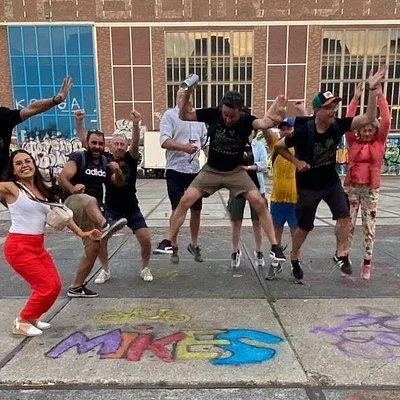
Amsterdam's Hidden Gems and Street Art Bike Tour
Experience Amsterdam's urban and alternative side as we take you on a unique tour of the city's lesser-visited places.
Book on ViatorBeyond STRAAT's walls, the surrounding terrain is equally alive. Walk toward the IJ and you'll find pieces that change monthly — some commissioned, some not. The neighborhood's creative community (including over 250 artists' studios) ensures the outdoor gallery never goes static. The NDSM halls themselves, covered in layers of paste-ups and tags, document a decade of Amsterdam's graffiti evolution.
Plan your visit: STRAAT opens Monday from noon to 5 PM, Tuesday through Sunday from 10 AM to 5 PM. First Fridays extend hours until 9 PM with DJ sets and a lively bar scene. Adult admission runs €21. The 2026 exhibition "the ESSENCE" explores graffiti's cultural meaning through December — a rare institutional look at the movement's roots. Skip the café if you're hungry; the on-site options are decent but limited, and the Noorderlicht café across the wharf offers better views.
Spuistraat: Legal Walls in the City Center
Most visitors walk Spuistraat without realizing they're passing through one of Amsterdam's most contested street art zones. This narrow street between Dam Square and the Singel canal has hosted legal painting walls since the 1980s, when the city designated specific facades for graffiti.
The paradox: Spuistraat sits in the tourist-heavy center, yet its art speaks to locals. Sections of wall change ownership regularly — what you see in June might be gone by August. That impermanence is part of the appeal. The street also carries political weight; several murals here responded directly to Amsterdam's housing crisis and gentrification debates.
Check the walls near the intersection with Raamgracht, plus the stretch approaching the Paleis voor Volksvlijt. Unlike NDSM's curated pieces, Spuistraat rewards patience. You'll find wheat-pasted posters layered over tags, stencil work tucked into doorways, and the occasional full-wall commission from Dutch artists like Hugo Kaagman, who pioneered the city's stencil style in the 1980s.
A note on timing: Early mornings (before 9 AM) offer the clearest views without tour groups. The street's proximity to the Red Light District means late afternoons bring crowds — and occasional opportunistic tagging that can obscure the better work.
De Pijp and the Albert Cuyp Surroundings
De Pijp rarely appears in street art roundups, which is precisely why it deserves attention. This 19th-century working-class neighborhood, centered on the Albert Cuyp market, carries a visual history of Amsterdam's immigrant communities — and the artists who've responded to that diversity.
The side streets between Ferdinand Bolstraat and the Sarphatipark hide some of the neighborhood's best pieces. Look for the large-format portraits along Eerste Sweelinckstraat and the abstract geometric work near the Marie Heinekenplein. Unlike NDSM's industrial scale or Spuistraat's legal walls, De Pijp's art feels integrated into daily life — pieces appear above bakeries, beside bike shops, across from the market stalls.
The neighborhood also hosts smaller galleries that bridge the gap between street and institution. Several former squats in the area have evolved into artist-run spaces where muralists show indoor work. If you're visiting on a Saturday, the Albert Cuyp market provides a natural starting point — grab a stroopwafel and wander the side streets between purchases.
Combine with: The Heineken Experience sits at De Pijp's northern edge, but for street art purposes, walk south toward the Sarphatipark. The park itself occasionally hosts temporary installations, and the surrounding streets offer the neighborhood's densest concentration of murals.
The Jordaan: Hidden Courtyards and Canal-Side Tags
The Jordaan's 17th-century grid — narrow streets, hidden courtyards, canals lined with houseboats — seems an unlikely home for street art. Yet this former working-class quarter, gentrified over the past three decades, retains pockets of visual rebellion.
The art here is subtler than NDSM's massive murals. You'll find it in the hofjes (courtyards) tucked behind street-level doors, where residents have commissioned small works that speak to the neighborhood's history. Along the Noordermarkt on Monday mornings, when the flea market sets up, you'll spot paste-ups on temporary stalls.
The most interesting Jordaan street art sits along the Prinsengracht's western stretches, where the canal walls double as canvases. These pieces tend toward the political — stencils critiquing tourism's impact, tags referencing the neighborhood's displacement pressures, small portraits of the market vendors who've worked the area for decades.
A local's tip: Walk the Noordermarkt's perimeter before the market officially opens. The stallholders arrive early, and the quiet streets offer unimpeded views of the area's best work. The nearby Anne Frank House draws crowds year-round; the street art waits just a few blocks away, uncrowded and free.
Oost: The Up-and-Coming Canvas
Amsterdam Oost — particularly the neighborhoods around the Dapperbuurt and Oosterpark — has emerged as the city's most dynamic street art frontier. Less polished than NDSM, less historic than Spuistraat, this eastern district carries the energy of a scene still forming.
The Dapperbuurt's multicultural market streets host murals that reflect the neighborhood's Surinamese, Turkish, and Moroccan communities. The works along de Dappermarkt's side streets tend toward portraiture and social commentary — artists responding to the area's demographic shifts in ways the center's galleries rarely capture.
Near Oosterpark, the walls along the Linnaeusstraat have become a rotating gallery of Amsterdam's mid-career muralists. These pieces are larger and more ambitious than the Jordaan's subtle interventions, but they lack the institutional backing of NDSM. What they offer instead is authenticity — art that exists because the neighborhood wanted it, not because a developer commissioned it.
When to go: Sunday mornings, when the Dappermarkt operates and the neighborhood feels most alive. The market runs until 5 PM, giving you ample time to explore the surrounding streets. Combine with a visit to the nearby Oosterpark for a full morning of art and green space.
Practical Tips for Your Street Art Walk
Start with STRAAT for context. The museum's collection spans the movement's history and geography, giving you visual vocabulary before you hit the streets. Its location in NDSM also positions you perfectly for exploring the wharf's outdoor pieces.
Use the free ferries. The IJ ferries behind Centraal Station run 24/7 and cost nothing. They're the fastest way to NDSM and offer the best views of the waterfront's industrial architecture.
Check what's changed before you go. Street art is ephemeral by nature. STRAAT's website updates its exhibition calendar, but outdoor pieces change without notice. Consider checking Instagram tags for #amsterdamstreetart in the week before your visit to see recent work.
Skip the guided street art tours in the center. City regulations have restricted tours in the Red Light District since 2020, and most "street art" walks in the center cover work that's either gone or underwhelming. Your time is better spent exploring independently — or taking a guided tour at STRAAT, where the €10 supplement includes expert context.
Combine with the city's other art institutions. Street art doesn't exist in isolation. The Rijksmuseum's Dutch masters share DNA with contemporary muralists — both respond to their moment, their city, their materials.
Rembrandt's house, just a few minutes from the center's street art zones, offers another lens on how artists have always used Amsterdam as their canvas.
FAQ
Is Amsterdam's street art legal?
It depends. NDSM Wharf and STRAAT Museum operate with full permission. Spuistraat has designated legal walls where graffiti is permitted. Most other street art in the city exists in a gray zone — tolerated in some areas, actively removed in others. The city's approach varies by neighborhood and property owner.
What's the best time of year for street art in Amsterdam?
Spring and early summer offer the most comfortable walking conditions. STRAAT's 2026 exhibition "the ESSENCE" runs through December, making it a year-round draw. Winter visits work too, though you'll want to plan indoor stops between outdoor stretches.
How much time should I allocate?
A focused STRAAT visit takes 2-3 hours. Add another 1-2 hours to explore NDSM's outdoor pieces. The center's Spuistraat and Jordaan areas can be covered in a half-day walking loop. For a complete picture, budget a full day across two neighborhoods.
Can I photograph the street art?
Yes, with caveats. STRAAT permits photography for personal use. Outdoor pieces are public — photograph freely. However, be respectful of residents and businesses whose walls host the art. Don't block doorways or bike racks while shooting.
Are there street art festivals in Amsterdam?
NDSM hosts periodic mural festivals and open studio events, though schedules vary year to year. STRAAT's first-Friday evening openings (until 9 PM) offer a festival-like atmosphere with music and a bar. Check the museum's calendar before your visit.
How does Amsterdam's street art compare to other European cities?
Amsterdam's scene is smaller than Berlin's or London's but more concentrated. The combination of NDSM's industrial scale, Spuistraat's legal walls, and the neighborhoods' integrated pieces creates unusual variety within a compact area. Most visitors can experience the full spectrum in a single day.
Some links below are affiliate links — we may earn a commission at no extra cost to you, which helps keep our guides free.
Book these experiences

Amsterdam's Market Street Food Tour with Streat Bites
If food is the center of your trips abroad, you can kick back, put your feet up, and smile. You’re in for an adventure.
Book on Viator